How cable ties are made: from a block of steel to a box of 1,000
Most explanations of how zip ties are made get it wrong in the first paragraph. They describe a plastic strip being extruded, then a head being attached to one end.
There is no attaching. A cable tie leaves the mold as one finished piece, pawl and teeth included, in a single shot, in about twenty seconds. Everything else in this article follows from that one fact.
Here is the real sequence, in the order it happens on the floor.
It starts with a mold, not an extruder
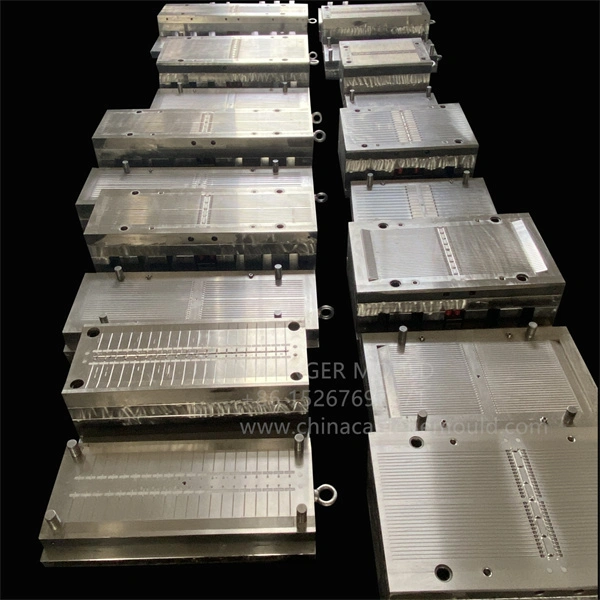
The machine that makes a cable tie is an ordinary injection molding machine. The thing that makes it a cable tie machine is the mold sitting in the platens.
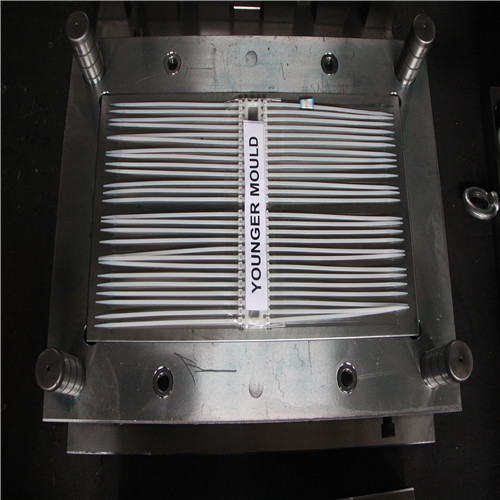
A cable tie mold holds somewhere between 2 and 24 cavities. Each cavity is a mirror image of the tie, cut into hardened steel, with the strap as a channel a little under a millimeter deep and the head as a blocky pocket four or five times thicker. Water lines run behind both, close to the surface, because the plastic has to be cold before it can be pushed out.
Take a tie off your desk and look at the tail. The last 10 mm is thinner than the rest, and the very tip is chamfered. That is not a cost saving. It is a lead-in, so the tail finds the slot in the head instead of jamming against it. Somewhere in the mold there is a tiny blade of steel cutting that taper, and if it wears, the ties stop feeding.
The head is where the mold gets difficult
The strap is easy. Long, flat, thin, no undercuts. Any shop can cut that.
The head is not. Inside it sits the pawl, a small tongue with teeth that has to bend out of the way as the tail passes and then spring back to lock against it. It is molded in place, in the same shot, in the same cavity, as part of the same piece of plastic. Nothing is glued or welded afterwards.
That tongue is an undercut. The mold cannot simply pull straight off it, so there has to be a slider, a lifter, or a split that opens first. On a 4-cavity tool that means four small mechanisms that all have to move at the right moment, every cycle, twenty times a minute, for years.
This is also where the gate goes. A cable tie is gated at the head, because the head is the thick section and thick sections feed thin ones. Gate it on the strap instead and you get a witness mark on the surface people look at, and a flow front that arrives at the pawl from the wrong direction, which is how you end up with a weld line across the one feature that takes the load.
Cooling is most of the cycle, and the head sets it
If a tie takes 20 seconds to mold, roughly 12 to 14 of those seconds are cooling. The rest is injection, packing, and the mold opening and closing.
The reason a tie runs slower than its thin wall suggests is that the cycle is not decided by the strap. It is decided by the head. Four millimeters of nylon takes a lot longer to set than one millimeter, and you cannot eject while the head is still soft, or the ties come out with oval heads and pawls that do not spring.
So the expensive engineering goes into cooling the head. Baffles drilled into the core, sometimes a beryllium copper insert behind the pawl, water at a temperature that keeps the nylon from warping. A mold that skips this still makes ties. It just makes them four seconds slower and slightly banana-shaped, and four seconds on a 20-second cycle is a fifth of your capacity.
So where does the assembly myth come from
Two places.
First, some cheap ties really do look assembled, because the head has a visible seam or a rough nub where the sprue was cut. That is not assembly. That is degating, done by hand with a pair of side cutters or by a blade in the mold.
Second, there are multi-piece fasteners that look like cable ties and are not. Reusable cable clamps, stainless steel ties, hook and loop straps. Those get assembled. A nylon cable tie does not.
If a supplier tells you their ties are "assembled by hand for quality", they are either selling you a different product or they do not know how their own product is made.
Cutting the runner off is a real cost line
Every shot produces the ties plus a runner: the plastic that filled the sprue and the channels leading to each cavity.
On a cold runner mold, that runner is cut off after ejection, either by an operator with cutters or by a degating jig. Both leave a small witness at the gate. On a hot runner mold there is no runner at all, the gate breaks cleanly when the mold opens, and the ties come out ready to pack.
This is one of the reasons hot runner tools cost more and run cheaper. No runner means no labor to cut it, no regrind to blend back in, and no pile of nylon offcuts next to the press. For a small tie running millions of pieces, the labor saved on degating alone often pays for the hot runner in under two years.
Drying the nylon is not optional, and it is not the mold's fault
Nylon 66 pulls moisture out of the air. A sack left open overnight in a humid plant can pick up enough water to ruin a shift. Push wet nylon through a barrel at 280°C and the water flashes to steam inside the melt. What comes out has silver streaks down the strap, a chalky surface, and a tensile figure 20 to 30 percent under the data sheet even though every dimension is in tolerance.
The fix is a hopper dryer at 80°C for about four hours, and a moisture reading under 0.2 percent before anyone loads the machine.
This is worth knowing because it is the first thing a molder blames the mold for. A tool can be perfect and still produce brittle zip ties if the resin went in wet. When a batch comes back snapping at the pawl, the question is not only what the cavity looks like. It is also what the dryer was set to that morning, and whether anyone wrote it down.
Then the ties get tested, not just looked at
Every batch gets a click test. Take a tie, feed the tail through, pull. It should lock with an audible click and hold. Do it again on twenty pieces from the same cavity, because a single bad cavity is the most common defect in multi-cavity tools.
Then a tensile pull to the rated load. A 200 mm tie with a 4.8 mm strap is usually rated around 22 kg. The sample goes on a testing machine, gets pulled to that number, and either holds or it does not. If it holds at 22 and slips at 19, that is a fail even though the number looks close.
There is also a visual check that most buyers never think about: bending the pawl by hand and looking for whitening at the hinge. Nylon that has been molded too cold, or cooled too fast, turns pale at the flex point. It will still pass a click test today. It will fail in a customer's hands in six months.
color is a separate production problem
Natural nylon is translucent, slightly off-white, and it yellows in sunlight within a season. Black ties are black because carbon black is the cheapest effective UV stabilizer, which is why outdoor ties are almost always black.
color comes from masterbatch, dosed at around 2 percent at the machine. Going from black to a specific red is not a five-minute change. The barrel, the hot runner, and the mold all hold the previous color, so a color change can eat half a shift in purging and scrap. That is why a run of 5,000 ties in a custom color costs more per piece than 500,000 in black, and why a supplier quoting you the same unit price for both is quoting something they have not thought about.
Packing, and the counting trick
Ties are packed 100 to a bag, and the bag is checked by weight, not by counting to a hundred. A good packing line weighs the bag and compares against the theoretical weight of 100 pieces from the shot weight, allowing a couple of percent.
This matters more than it sounds. If your supplier's shot weight is off, or their cavity count does not match their paperwork, you find out as a bag that is 3 grams light, which is one tie missing, which the end user discovers on a job site.
The numbers on a tie, and where they come from
Standard ties come in 2.5, 3.6, 4.8, 7.6 and 9.0 mm widths. Those are not arbitrary steps. Each width pairs with a head size and a pawl that fits it, and the tensile rating scales with the cross section rather than with the length. A 100 mm tie and a 300 mm tie in the same width hold roughly the same load, because the strap that fails is the strap in the pawl, not the long part.
Rough working numbers, for plain nylon 66: 2.5 mm around 8 kg, 3.6 mm around 18 kg, 4.8 mm around 22 kg, 7.6 mm around 54 kg, 9.0 mm around 79 kg. Width is normally held to plus or minus 0.1 mm and thickness to plus or minus 0.05 mm, and those two tolerances together decide whether the tail slides through the head slot freely or jams halfway.
One more thing that surprises buyers: most manufacturers run a family mold rather than a separate tool per length. The head is the expensive geometry, so it is cut once, and the strap is just a longer or shorter channel branching off the same runner. That is why adding a new length to an existing size costs a fraction of a new mold, and why your supplier should quote it that way.
What all of this means if you are the one buying the mold
The whole product is decided in the first two weeks of a project, in a room with a CAD screen.
Cavity count sets your machine tonnage, your labor per thousand pieces, and your maintenance cost. Steel choice sets whether the mold is still making clean teeth after 800,000 shots or rounding them off at 200,000. Pawl design sets whether the tie holds at 22 kg or slips at 19. Cooling design sets the cycle, and the cycle is where the money is.
Which is why it is worth asking a supplier what happens inside the head of their mold, rather than how many years they have been in business. Anyone can answer the second question.
At Youger Mold we have been building cable tie molds in Taizhou, China for over fifteen years, mostly 2 to 24 cavities, cold and hot runner, with the pawl geometry in replaceable inserts as standard. We are a cable tie mold manufacturer, not a trading company, which means the person answering your technical question is the person who will be standing at the trial.
If you are sourcing zip ties rather than the tooling, most of this still applies. Ask your mold supplier what steel the cavities run and how often they change the pawl inserts. The ones who answer clearly are the ones whose ties hold at the rated load in year three.
Questions people actually ask
Are cable ties really one piece? Yes. The strap, head, pawl, and teeth come out of one cavity in one shot. There is no assembly step, on any nylon cable tie, at any price.
What plastic are they made of? Mostly nylon 66, sometimes nylon 6, occasionally PP for very light duty work. Nylon 66 is stiffer, absorbs less moisture, and holds tension better over time. Glass-filled nylon appears in heavy-duty and wide-band ties, and it is much harder on the mold.
Why do some ties break right at the head? Usually a weld line at the pawl, or a gate placed so the flow front meets itself across the thinnest part of the tongue. Occasionally it is cold material from a worn hot tip. It is a mold problem, not a resin problem, nine times out of ten.
How long does a cable tie mold last? A pre-hardened P20 or 718H tool is good for a few hundred thousand shots. Hardened H13 in the cavities will pass a million. The pawl inserts wear first either way, which is why they should be replaceable.
Can I get a custom length or a custom color? Both, and length is cheap because it is just a longer cavity. color is the expensive one, mostly in setup time. Plan your sizes around a single color per run and the price stays sensible.
Why are black ties stronger in the sun? Carbon black blocks UV. Natural nylon has no such protection and will chalk and embrittle outdoors within a season or two. It is a material decision, not a marketing one.